 Telegram
 WhatsApp
 Twitter
 LinkedIn
Industrial Automation Project Execution: The Ultimate 10-Step Field Checklist
Reading Time: 4 minutes
Author: Electrical Engineering Mohamad Zamani — Industrial Automation Design & Commissioning Engineer
Introduction
If there is one lesson I have learned over years of fieldwork in industrial automation projects, it is this: project success is determined long before you set foot in the plant — it is decided during the preparation phase. I have seen seasoned engineers stranded for hours, sometimes days, on an industrial site simply because they forgot a communication module or miscalculated a power budget. Lost time on the factory floor directly translates to production downtime and financial loss for the client.
In this article, I present a professional 10-step checklist for PLC-based project execution — one I have personally relied on across projects in steel, petrochemical, and cement industries.
1. Field Instrumentation Audit — Actuators & Sensors
The first step is a complete inventory of all I/O signals. You must know exactly:
- How many discrete/digital sensors? (Limit switches, reed switches, proximity sensors, encoders)
- How many analog sensors? (RTDs/PT100, thermocouples, 4–20 mA transmitters, load cells)
- What type of output actuators? Pneumatic valves (DO), VFDs (AO / fieldbus), contactors?
Golden Rule: Always reserve 15–20% spare I/O capacity for future expansion. This foresight has allowed many of my projects to go through expansion phases without hardware replacement.
2. I/O Module Sizing & Selection
Once signals are counted, it is time to select I/O modules:
- DI Module: For discrete sensors (typically 8, 16, or 32-channel)
- DO Module: For actuator commands — relay output for low-frequency switching, transistor for high-frequency
- AI Module: For analog signals with appropriate resolution (12, 13, or 16-bit)
- AO Module: For continuous control loops (control valves, VFD speed reference)
Field Experience: In harsh industrial environments (dust, high temperature, vibration), always specify isolated modules. The higher upfront cost is recovered through dramatically reduced failure rates over the asset lifecycle.
3. CPU/Processor Selection
The CPU is the heart of the system.
4. Specialty Module Specification — FM, CP & IM
This covers modules beyond basic I/O:
- FM (Function Module): High-speed counter (HSC), positioning/motion control, standalone PID controller
- CP (Communication Processor): Gateway to MES/ERP layer, serial (RS-232/485, MODBUS RTU), or dedicated industrial protocols
- IM (Interface Module): Remote I/O rack expansion for projects with high module counts
5. Power Budget Calculation & PSU Sizing
Calculating total power consumption is one of the most critical — yet most overlooked — steps:
- Extract current draw for every module from datasheets
- Account for inrush current at power-up
- Apply a safety factor of 1.25× to 1.5×
- Use an industrial UPS for critical loads (CPU, safety I/O modules)
Warning: An undersized or unstable power supply is the #1 cause of intermittent faults and erratic PLC behavior — and debugging it is a nightmare!
6. Hardware Configuration & Topology Setup
Inside the engineering framework (TIA Portal, Studio 5000, EcoStruxure Control Expert):
- Create a new project and select the correct CPU part number
- Configure all modules exactly matching the physical rack layout and slot assignment
- Verify and reassign I/O addressing (byte/word/DWord) as needed
- Document all network settings: IP Address, Subnet Mask, Default Gateway
7. Software Architecture & Block-Based Programming
A well-structured program is modular and readable. Recommended architecture:
- OB1: Main cyclic scan, calling sub-blocks
- FBs (Function Blocks): Reusable blocks for repetitive plant objects (motor, valve, PID loop) — each with its own Instance DB
- FCs (Functions): Stateless logic, calculations, and parameter-assignable subroutines
- DBs (Data Blocks): Global storage for setpoints, parameters, and recipe data
IEC 61131-3 Languages: LAD, FBD, SCL, STL, or Graph — choose the right language for the task. Each block should have a single, well-defined responsibility. This principle makes testing and troubleshooting dramatically easier.
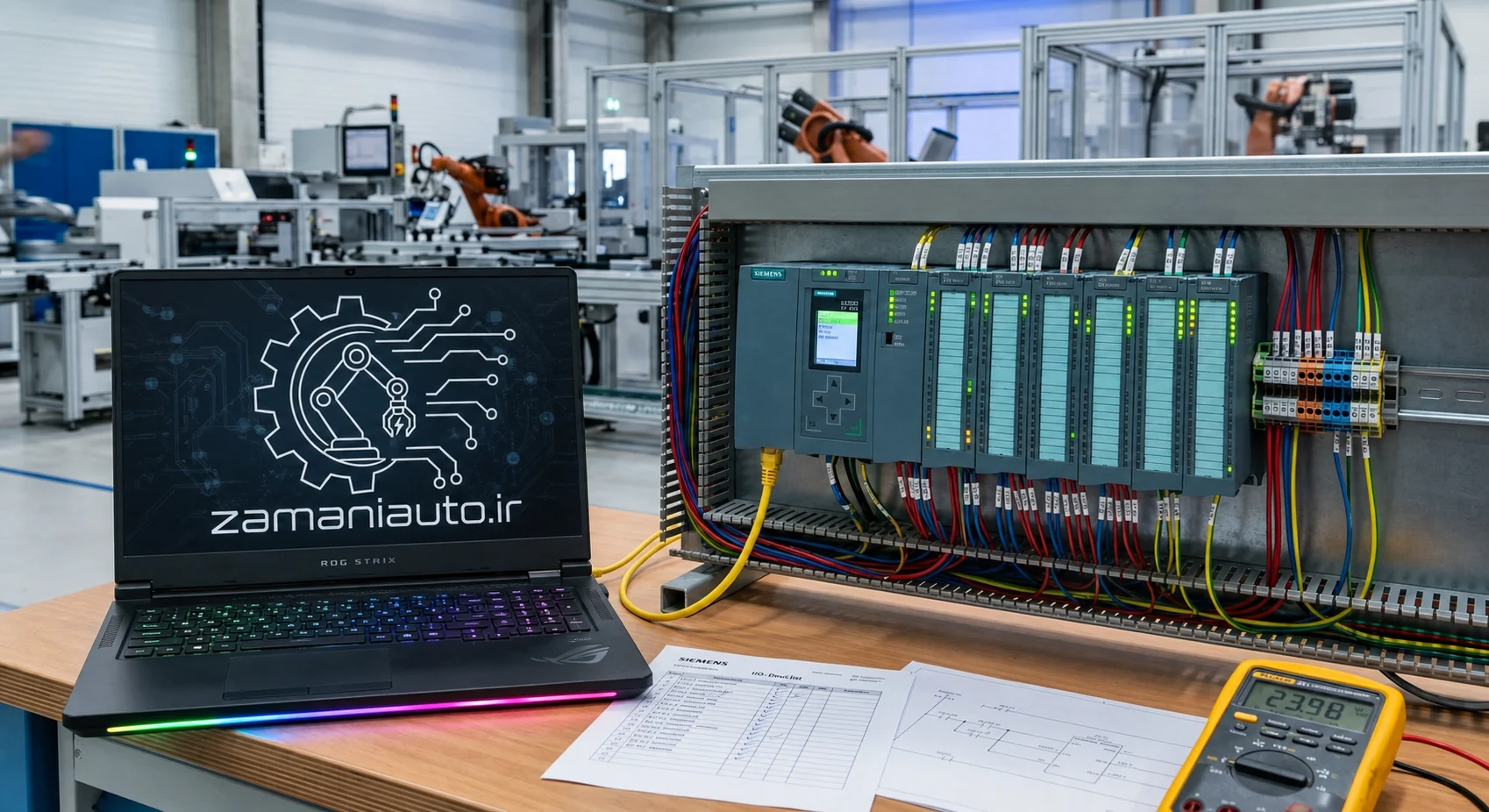
8. PG/PC-to-PLC Communication & Download
Before heading to the site, test communication in the workshop:
- Industrial Ethernet cable (CAT6), USB-to-Serial adapter, or the required communication processor
- PG/PC Interface settings in your OS control panel
- Temporarily disable the firewall — this alone is the #1 source of connectivity headaches!
- Perform a complete download (HW Configuration + Software) and verify the CPU transitions to RUN mode
9. Commissioning & I/O Checkout
On-site, proceed step by step:
- Download the program with the CPU in STOP mode first
- One by one, test every input signal by physically actuating the field device (use Watch Table / Force Table)
- Test each output individually using Force (with strict safety lockout procedures)
- Only when all I/O points are verified, switch the CPU to RUN
- Always keep a golden backup image on external memory (MMC/SD card)
10. Software Tuning & Post-Commissioning Refinement
After the initial startup, the monitoring and refinement phase begins:
- Observe system behavior under real process conditions
- Investigate any unexpected scan cycle time spikes — check OB1 watchdog
- Fine-tune alarms and deadbands based on operator feedback
- Complete as-built documentation: circuit diagrams, I/O list, P&ID markups, and source code comments — all fully updated
Summary: The F ormula for Automation Project Success
These 10 steps are the distillation of years of field experience across Iran's heavy industries. Follow this checklist diligently, and I guarantee your project will reach completion with minimal headaches and maximum quality.
Questions or field stories to share? I'd love to hear them in the comments. If you would like a downloadable PDF version of this checklist, let me know and I will prepare one for you.
*© 2026 — All rights reserved.*